
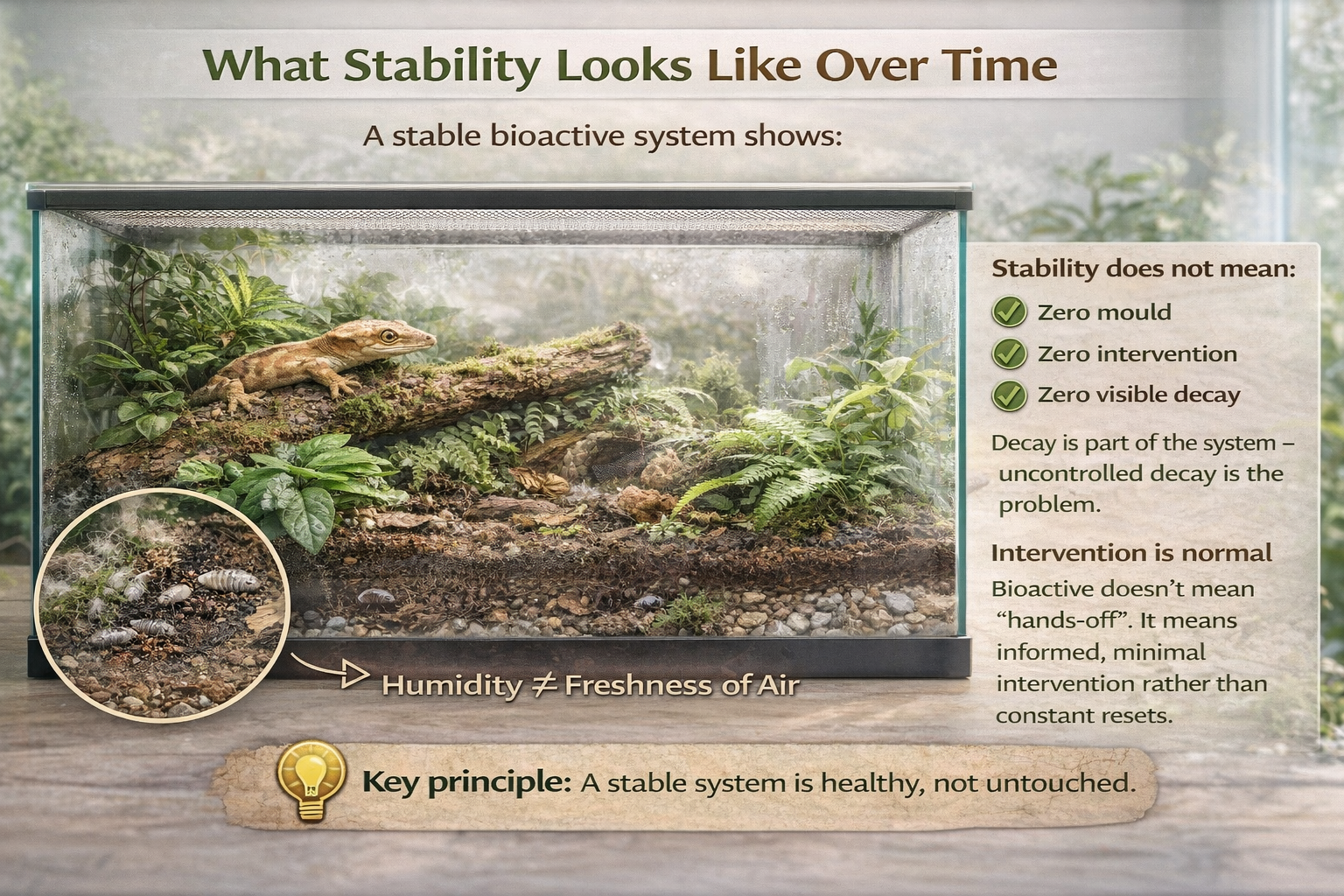
The term bioactive vivarium is used widely, but often loosely. In recent years it has come to describe almost any enclosure that includes plants and a clean-up crew. While these elements are important, they do not on their own make a system truly bioactive.
A genuinely bioactive vivarium is not defined by what it contains, but by what it does. It is a living system, designed to support biological processes that recycle waste, stabilise conditions, and reduce long-term intervention — all while prioritising the welfare of the animals within it.
This article explores what bioactive really means in practice, why so many systems struggle to remain stable, and how a principle-led approach leads to better outcomes than copying a build list or following trends.
What “bioactive” actually means
At its core, bioactive refers to biological activity — the ongoing interaction between organisms and their environment. In a vivarium, this activity revolves around decomposition, nutrient cycling, and microbial processes.
In a functional bioactive system:
- Organic waste is broken down rather than removed
- Nutrients are recycled back into the substrate and plants
- Microorganisms play a central role in maintaining balance
- Conditions stabilise over time instead of degrading
Plants and invertebrates are not decorative additions; they are active components in a system designed to function as a simplified ecosystem.
A vivarium becomes bioactive not when life is added, but when biological processes are intentionally supported.
Bioactive is a system, not a setup
One of the most common misconceptions is that bioactive vivariums are a fixed recipe: a specific substrate mix, a drainage layer, a clean-up crew, and a list of plants.
In reality, bioactive systems are context-dependent. What works in one enclosure may fail in another if the underlying conditions differ.
A successful system considers:
- The species being housed and their behaviour
- Moisture levels and airflow
- Temperature gradients
- The rate at which waste is produced
- The ability of the system to process that waste
Without understanding how these factors interact, even the most carefully assembled enclosure can become unstable over time.
The core components — and their roles
Substrate: more than something to plant into
In a bioactive vivarium, the substrate is not simply a growing medium. It is the foundation of the system.
A functional substrate supports:
- Microbial life
- Moisture regulation
- Gas exchange
- Nutrient storage and release
Depth, composition, and structure matter more than specific ingredients. A substrate that remains compacted, waterlogged, or anaerobic will undermine bioactivity, regardless of what lives on the surface.
The goal is not richness, but functionality.
Drainage: when it helps — and when it doesn’t
Drainage layers are often treated as mandatory, but they are a tool rather than a rule.
Drainage is useful when:
- High moisture levels are required
- Substrate depth is significant
- Water input exceeds evaporation and uptake
However, unnecessary drainage layers can reduce usable substrate volume and complicate moisture management.
A bioactive design should be based on moisture behaviour, not habit. In some systems, controlled substrate structure and airflow achieve better long-term stability than drainage alone.
Clean-up crews: roles before species
Invertebrates are often introduced early, but rarely understood in terms of function.
A clean-up crew exists to:
- Break down waste
- Fragment organic material
- Support microbial activity
Different invertebrates perform different roles, and no single species does everything well. More importantly, their success depends on suitable conditions — moisture, shelter, and food sources — which are often overlooked once they are added.
A clean-up crew does not replace maintenance. It changes the type of maintenance required.
Plants as active participants
Plants in a bioactive vivarium are not static décor. They regulate humidity, stabilise substrates, absorb nutrients, and influence microclimates.
Poor plant choice is one of the fastest ways to destabilise a system. Plants that rot, collapse, or outgrow the enclosure disrupt balance rather than supporting it.
Effective bioactive planting prioritises:
- Root structure
- Growth habit
- Compatibility with moisture and light levels
- Long-term manageability
Healthy plants are indicators of system health — not just aesthetic success.
Why many bioactive vivariums fail
Most bioactive failures are not dramatic. They are slow declines: odours, persistent mould, plant loss, declining clean-up crews, or animals that never quite thrive.
Common causes include:
- Over-saturated substrates with poor airflow
- Systems built for appearance rather than function
- Incompatible species and enclosure conditions
- Underestimating waste load
- Expecting “self-cleaning” performance
These issues rarely stem from lack of effort. They stem from designing around components instead of processes.
Bioactive does not mean low maintenance
One of the most damaging myths is that bioactive systems are maintenance-free.
In reality, they require:
- Observation rather than routine cleaning
- Adjustment rather than replacement
- Understanding rather than automation
Maintenance does not disappear; it becomes more subtle and more important. Successful keepers learn to read their systems — moisture behaviour, plant response, invertebrate activity — and intervene early when balance shifts.
Bioactive systems reward attentiveness, not neglect.
Who bioactive systems are (and aren’t) for
Bioactive vivariums are not the right choice for every keeper or every situation.
They are best suited to people who:
- Enjoy learning how systems work
- Are patient with gradual development
- Value long-term stability over quick results
They may not suit those looking for:
- Instant visual results
- Minimal involvement
- A substitute for husbandry knowledge
Choosing bioactive is a commitment to understanding, not a shortcut.
What Bioactive Vivarium Academy is here to do
Bioactive Vivarium Academy exists to move the conversation away from checklists and towards comprehension.
Rather than telling people what to buy, the Academy focuses on explaining:
- Why systems behave the way they do
- How design choices affect outcomes
- What makes enclosures stable over time
When keepers understand the principles behind bioactive systems, they make better decisions — for their enclosures and for the animals they care for.
Bioactivity is not a trend. It is a way of thinking.